
AI Readiness Findings for Central Asia and the Caucasus Presented at ICT WEEK Uzbekistan
On September 22, as part of ICT WEEK Uzbekistan 2026, findings from The Next AI Frontier: Central Asia and the Caucasus in the Global Technology Shift were presented during the panel session, “From Research to AI Startups: How Scientific Ideas Become Global Products.”
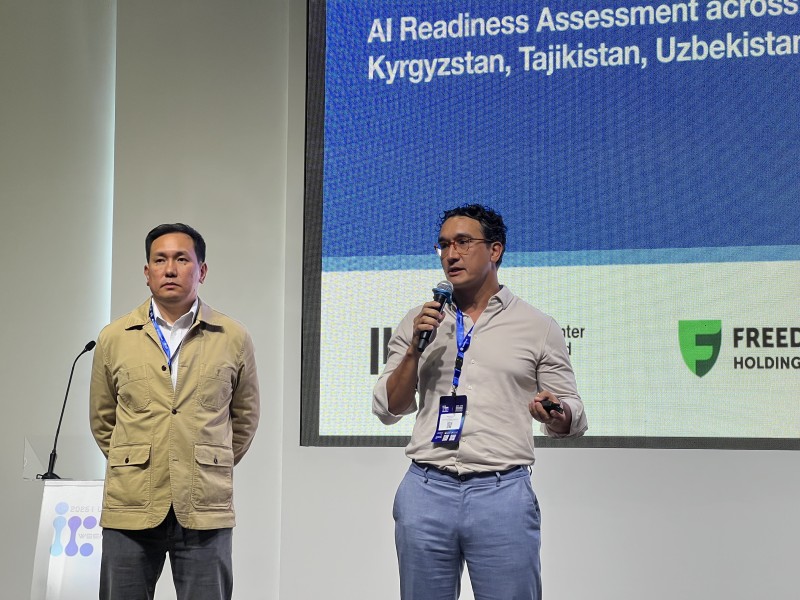 The inaugural study assesses AI readiness across Central Asia and the Caucasus, focusing on Kazakhstan, Kyrgyzstan, Tajikistan, Uzbekistan, and Azerbaijan. Shamil Ibragimov, Director of Research at the MIT Kuo Sharper Center for Prosperity and Entrepreneurship, and Asset Abdualiyev, Founder and CEO of Silkroad Innovation Hub, presented the assessment results.
The report is being developed jointly by researchers at the MIT Kuo Sharper Center and experts from Silkroad Innovation Hub, with the support of IT Park Uzbekistan, Astana Hub, and Freedom Holding. The full report is scheduled for publication in October 2026 by the MIT Kuo Sharper Center for Prosperity and Entrepreneurship.
“Central Asia is entering a new stage of AI development, and Uzbekistan has an opportunity to play an active role in shaping this growth. Our priority is to build an ecosystem where infrastructure, talent, research, startups, and businesses are closely connected, allowing technological potential to translate into scalable products and real economic value. Studies like this give us a clearer picture of the region’s strengths and gaps and help identify where stronger cooperation can accelerate AI development,” said Azamat Karamatov, CEO of IT Park Uzbekistan.
The AI Readiness Assessment is structured around four core pillars that provide a comprehensive view of each country’s capacity to develop and deploy AI at scale:
- Government Readiness and Enabling Legal Environment: from national strategies and legislation to institutional implementation and public-sector capacity.
- Hardware, Energy, and Infrastructure Readiness: from computing capacity and data centers to electricity and connectivity.
- Human Resources and Talent Capacity: from university research and education to professional training and talent retention.
- AI Adoption and Private-Sector Absorption: from startup development and corporate implementation to access to compute, capital, customers, and global markets.
“What we see is a region entering a new stage of AI development. This assessment brings together extensive data and insights from key stakeholders to capture developments across government, research, infrastructure, talent, and the private sector. It was not designed to rank countries against one another, but to understand the region as a whole, identify its shared strengths and gaps, and establish where Central Asia and the Caucasus stand today. It is the first comprehensive study of its kind to examine the region’s AI readiness through a common framework,” said Shamil Ibragimov, Director of Research at the MIT Kuo Sharper Center for Prosperity and Entrepreneurship.
The assessment results show that Central Asia and the Caucasus have made significant progress in AI development over the past three years. Large-scale educational initiatives such as Coursera, One Million Uzbek Coders, and AI-Sana are expanding access to AI skills and developing the region’s talent base, while emerging legislative and regulatory frameworks are creating a more supportive environment for AI infrastructure development and innovation.
“Three years ago, the region had no major GPU infrastructure. Today, it has three TOP500 supercomputers, expanding research capacity, and a new generation of AI-native startups,” said Asset Abdualiyev, Founder and CEO of Silkroad Innovation Hub. “The question is no longer whether the region will participate in the global AI shift, but whether it can connect its infrastructure, talent, research, and businesses strongly enough to create lasting economic value.”
 The study analyzed 650 startups and surveyed 103 corporations, making it one of the largest regional assessments of AI readiness in the private sector.
The research concludes that Central Asia and the Caucasus are on track to emerge as an important AI region. The next step is to deepen cooperation across the five countries and strengthen connections between the region’s growing infrastructure, research institutions, talent, startups, corporations, and investors.
2026-09-22